



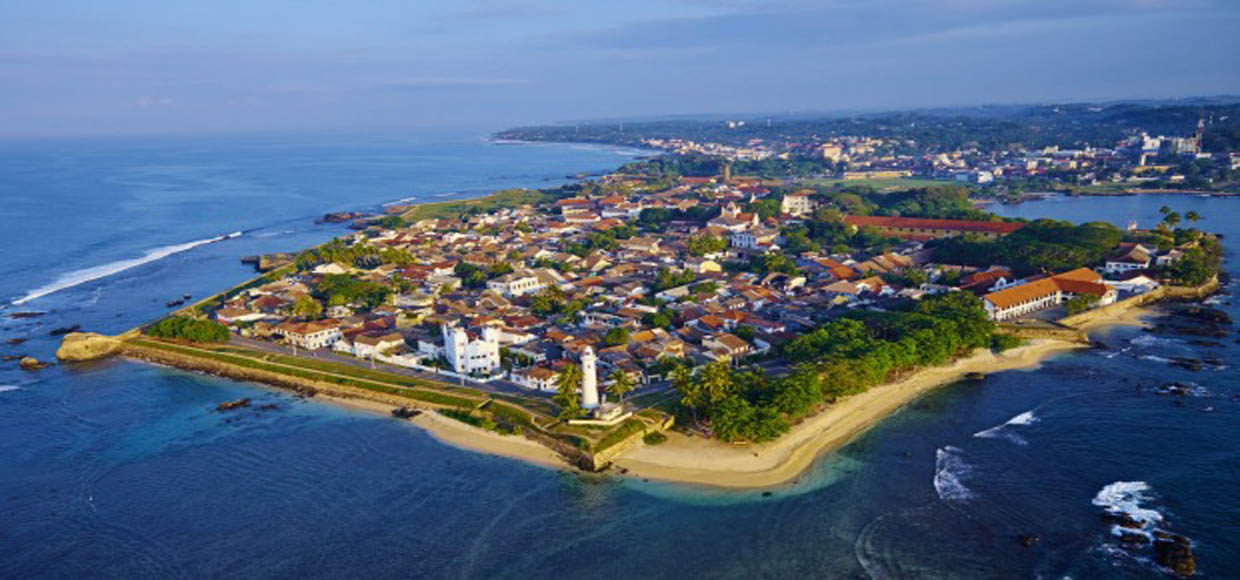
Galle, a city located in the south coast of Sri Lanka is one of the most popular destinations among the travelers around the world. It is a fine example of the colonial heritage brought the island through the centuries past. Before the colonials took charge of the city, it has been used as a port for a hundreds of years.
The name Galle is believed to have been derived from the Sinhalese word “gala”: a cattle fold or posting-place. There is another view that it has been come from the Sinhalese word “gala”( rock) which has been used by the Portuguese to adopt the Latin word “Gallus” (rooster).
In the year 1505, the first Portuguese entered Galle unexpectedly and thus began its time with the colonials. In 1587, they built a fort and established their control over the city. They built a single wall fronted by a moat that went from the sea to the harbor. The Portuguese were in control until the Dutch came and defeated them in the year 1640. The Dutch entered the port with 12 ships and an army of 2000 men led by the commander named Wilhelm Jacobsz Coster. The fighting went bloody and severe and ended with a four day siege. However, the Portuguese lost at the end. The Dutch built the fort to its magnificence which is present till date. The fort was of 36 hectares large and complete with all the essentials for a fort city.
In 1796, the British took the control and till they leave the island they retained the control over the city. The Galle port was one of the important stop which linked the east and the west and was popular among the explorers, and traders alike.
Today, the fort spreads across 90 acres and is considered an amazing monument of the colonial period of Sri Lanka decorated with the aspects of Portuguese, Dutch as well as the British architecture. It has centuries old Dutch churches, monuments, Dutch houses and narrow alleys reminding you a completely different world in Sri Lanka with its western air. One is the New Oriental Hotel, which was built for a Dutch governor in 1684. There are other edifices still remaining with the same names and architecture of the colonial era including Closenburg, Eddystone, Barthfield, Armitage Hill/ Nooit-Gedacht, not to mention the street names such as Leyn-Baan Street, Zeeberg Street and Moderabaay Street.
One of the points of interest in the fort is the Dutch Church. It was built in 1754, on the site of a Portuguese Capuchin Convent and on an earlier Protestant, “Groote Kerk”, built in 1640. It is recorded that the Church was built by Gertruda Adrianna Le Grand, wife of the Commandeur Gasparus de Jong, for the long-prayed birth of a son. The edifice is hexagonal and is grained with wood and has a sounding board with iron rods and hoops.
Galle, as one of the best preserved forts among the Dutch colonies of the East, was declared a World Heritage Site by UNESCO in 1988. This living heritage site possess the great culture and historical and architectural aspects of the colonial era passed down through the centuries by the Portuguese, Dutch and British. It also has hotels and restaurants suiting to satisfy the conventional as well colonial taste of minds of travellers. And the souvenir shops and the romantic alleys and the ocean shining bright below the great walls of the fort shall heal the mind and body of the vexed.